
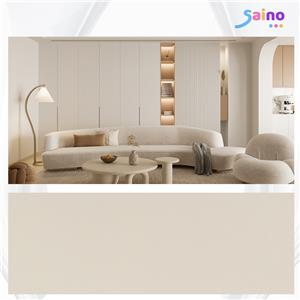
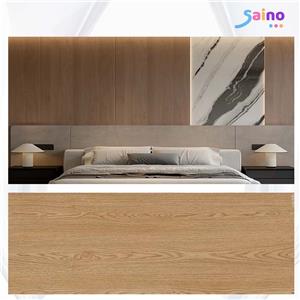
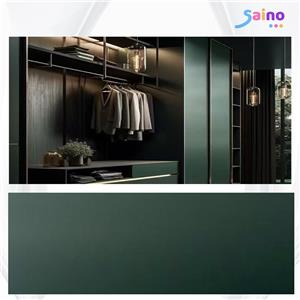
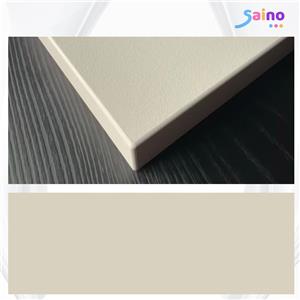
Why are PET Decorative Film and PUR Hot Melt Gule the best partners?
Synergistic compatibility analysis of PET decorative film and PUR hot melt adhesive: mechanism, advantages and application prospects
1. Characteristics of complementary materials: the physical and chemical basis of compatibility
PET Decorative Film has the characteristics of high surface hardness, good weather resistance, rich color, environmental protection and so on. However, its surface energy is low and chemical inertness is strong, resulting in insufficient interface bonding strength with traditional adhesives. The molecular structure of PUR (reactive polyurethane) hot melt adhesive contains isocyanate groups with high reactive activity, which can form a cross-linked network structure with the substrate under the action of moisture catalysis, which combines the processing convenience of hot melt adhesives and the excellent binding strength of reactive adhesives. The high mechanical strength of PET Decorative Film is combined with the flexible cross-linking network of PUR hot melt adhesive to form a composite system of "rigid and flexible", which can maintain interface stability even under the action of thermal stress.
2. Interface combination mechanism: from physical adsorption to chemical anchoring
The traditional interface combination relies on van der Waals force and mechanical interlock, while the PET/PUR system achieves a solid interface combination through triple synergy:
• Surface energy matching: Plasma treatment increases the surface energy of PET Decorative Film from ~40 mN/m to ≥50 mN/m, making it have good wetting properties with PUR hot melt adhesive;
• Chemical bond formation: the hydroxyl and carboxyl groups grafted to the surface of the PET react with the -NCO group in the PUR hot melt adhesive to form a polyurethane/urea bond, increasing the peeling strength to 8-12 N/25mm (in accordance with ISO 8510-2 standard);
• Shrinkage rate matching: The heat shrinkage rate (0.3%, ASTM D1204) of modified PUR hot melt adhesive is highly matched with the heat shrinkage rate (≤0.5%) of PET Decorative Film, which eliminates the risk of stratification.
3. Process adaptability: provide technical support for precision manufacturing
• Low-temperature activation characteristics: The activation temperature of PUR hot melt adhesive (110-130℃) is much lower than the glass transition temperature of PET film (~78℃) to avoid thermal deformation of the substrate;
• Rheological performance optimization: tactile PUR hot melt adhesive maintains zero penetration at a coating thickness of 0.1-0.3mm (in accordance with EN 12701 standard);
• Stress dissipation design: After curing, PUR hot melt adhesive forms an elastomer phase (energy storage modulus E'≈5 MPa), which can absorb 0.4% linear expansion of PET film caused by temperature changes.
4. Performance verification: durability in extreme environments
After 1000 hours of double 85 test (85℃/85% RH), the adhesive strength retention rate of the PET/PUR hot melt adhesive system is >85%, which is better than the traditional EVA system (<60%). In the thermal cycle test of -40℃~120℃, there was no cracking at the interface (in line with the IATF 16949 automotive interior standard), and its hydrolysis resistance (ASTM D3137) met the 25-year weather resistance requirements of outdoor building materials.
5. Industrialization value: from cost optimization to technology iteration
At present, the mass production cost of domestic PET/PUR composite film is 18-25% lower than that of imported products, and it supports customized spectral reflectivity (380-780nm band adjustable). In the field of automobile interior decoration, the system has passed the VOC emission test (≤50μg C/g) and meets the FMVSS 302 flame retardant standard, marking the evolution of polymer interface engineering from "bonding" to "functional integration".
Conclusion: Adaptive-driven industrial chain upgrade
The compatibility of PET Decorative Film and PUR hot melt adhesive is essentially the systematic integration of surface and interface science, polymer rheology and precision process control. The system not only solves the long-standing problem of "film-base separation" in the decoration industry, but also provides a transferable technical paradigm for flexible electronic packaging, new energy battery insulation and other fields through the directional design of material genomics. With the popularization of domestic high-speed PUR coating equipment (120 meters/minute) and online plasma processing modules, it is expected that by 2028, the market size of PET/PUR composite materials will exceed 20 billion yuan, becoming one of the material foundations of China's high-end manufacturing industry.